Modern art galleries demand lighting solutions that transcend standard commercial parameters. The design criteria for contemporary art exhibition spaces hinge on three fundamental pillars: conservation, fidelity, and flexibility. According to the international lighting guidelines for museum environments, exposing delicate paintings, organic pigments, and archival paper to improper spectral distributions can trigger irreversible photochemical degradation. This reality shifts the burden of performance directly onto the track lighting system.
When curating high-end galleries, engineers must demand a Color Rendering Index (CRI) with a minimum Ra value of 95, supplemented by an R9 (saturated red) value of 90 or above. Red wavelengths are notoriously difficult for standard LED chips to reproduce accurately, yet they constitute a vital component of skin tones, oil paintings, and historical textile colors. Furthermore, the modern TM-30-18 standard provides a multi-dimensional assessment framework including Fidelity Index ($R_f$) and Gamut Index ($R_g$), replacing the outdated 8-color test method to guarantee optimal color texture representation.
In North America, standards like the IESNA (Illuminating Engineering Society of North America) Handbook prescribe specific lux thresholds for different mediums: 50 lux for sensitive watercolors/prints, and up to 200 lux for oil paintings and stone sculptures. The dominance of J, H, and L-type 3-wire track channels necessitates high physical and electrical compatibility from exporting manufacturers.
Europe enforces stringent ecological and historical preservation metrics. Strict requirements regarding color temperature consistency over time and the reduction of blue-light hazards (EN 62471) drive the market toward high-grade COB (Chip-on-Board) packages that feature specialized phosphor layers targeting natural light profiles.
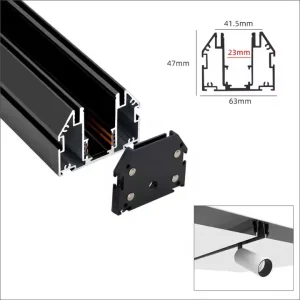
The rise of private museums and commercial mega-galleries in China, Singapore, and Japan has spurred demand for flexible architectural layouts. Key trends include the adoption of magnetic low-voltage tracks (such as DC48V systems) that allow secure, tool-free hot-swapping of optical heads as exhibitions rotate.
Lighting layout in a professional art gallery must adapt dynamically to the architectural topology of the room and the nature of the items on display. Let us examine three typical application layouts configured by global lighting engineers:
By utilizing narrow-beam reflectors (10° to 15°) with a high-density COB emitter, designers can isolate canvases from the surrounding walls, drawing focus to the texture of the brushstrokes. Incorporating honeycomb louvers minimizes glare, shielding the eyes of observers standing at various angles.
Displaying three-dimensional art requires a mixture of soft diffusion and hard highlights. Placing track spots at 30° and 60° relative angles relative to the sculpture ensures a clear sense of depth without harsh shadows that distort the artist’s spatial intent.
For large canvas collections and expansive graphics, uniform vertical illuminance is required. Linear wall-washer track modules with custom asymmetrical optical lenses ensure a smooth flow of light from the ceiling line down to the floor, eliminating hot spots and dark zones.
The track lighting sector is undergoing a rapid technological evolution, shifting from static high-CRI fixtures to responsive, spectral-tuned solid-state lighting arrays. Key developments include:
Enables curators to programmatically shift color temperature based on the style of the exhibit. Warm light (2700K–3000K) enhances gold leaf and traditional oil paintings, whereas cool light (4000K–5000K) makes modern contemporary blue-heavy pigments and minimalist displays pop.
Replacing traditional physical potentiometers, digital protocols allow granular wireless dimming down to 0.1% without flicking. This allows galleries to dim individual fixtures via mobile apps or tablet control panels based on real-time ambient lux measurements.
The newest optical engines utilize violet-excited chips to mimic natural sunlight across the visible spectrum, including the critical cyan gap. This maximizes color rendering performance while creating a comfortable environment that aligns with the circadian rhythms of visitors and gallery staff.
The global dominance of Chinese lighting exporters is backed by a highly optimized industrial supply chain, centered in Guangdong province. The concentration of aluminum extrusion plants, specialized driver manufacturers, glass coating facilities, and optical engineering laboratories within a 50-mile radius allows for rapid prototyping and unparalleled manufacturing scalability.
When sourcing track fixtures globally, working with an integrated manufacturer ensures strict quality control over every component—from the initial thermal simulation of the die-cast heatsink to the final chromaticity sorting of the COB LED chips. Standardized testing using high-accuracy integrating spheres and goniophotometers ensures that photometric files (.IES or .LDT formats) match physical performance, giving architects the data they need to build accurate digital mockups.
Founded in 2008, Guangdong Guangyao Lighting Co., Ltd. specializes in the R&D, production, and sales of high-performance LED lighting. Operating under strict ISO9001:2015 quality management systems, our products hold CE, 3C, SAA, and other major global certifications, backed by a comprehensive three-year warranty. We pride ourselves on delivering professional commercial lighting solutions and serving as a trusted OEM/ODM manufacturing partner for leading lighting brands worldwide.


Navigating different regulatory standards is critical when exporting lighting fixtures. As a global supplier, Guangdong Guangyao Lighting Co., Ltd. ensures that all products are fully compliant with target market regulations, minimizing customs friction and project delays:
Ensures that our electronic systems comply with standard electromagnetic compatibility (EMC) rules and restrict the use of hazardous substances like lead and mercury.
Guarantees that electrical insulation, mechanical strength, and driver designs are optimized for the standard 230V/240V grid systems across Oceania.
Conforms to the National Safety Standards of China, verifying mechanical rigidity, fire-resistant plastics, and ground connection reliability.
For museum and professional art display, a CRI (Ra) of 95 or above is highly recommended. The R9 value (saturated red rendering) should ideally be above 90, as standard CRI calculations only measure pastels and often miss key warm tones that are vital for oil paintings and fiber art.
Magnetic track systems run on safe DC48V power and use magnetic locking rather than physical mechanical twist-locks. This allows curators to quickly rearrange, swap, or add new lighting heads without needing tools or turning off the power, significantly speeding up exhibition changes.
These types refer to different standard track slot specifications used in the industry. H-type (Halo), J-type (Juno), and L-type (Lightolier) have slightly different contact configurations and busbar spacings. It is critical for exporters to offer adapters compatible with all three formats.
Ultraviolet (UV) light triggers rapid yellowing, fading, and chemical cracking of pigments. Infrared (IR) light generates heat, which causes local expansion and contraction of canvas fibers. Modern gallery-grade LED track heads are designed with filters or specialized phosphors to guarantee zero emission in these wavelengths.
 Guangyao Lighting